Tolerance for Invisibility
A friend recently told me about someone who left their job to start a business that revolved around their deepest passion. They had thrown themselves fully into the work, were extremely knowledgeable in the field, and had even studied further to support their efforts, only to simultaneously say, “I’m going to give myself five months to make this happen.” Five months came and went, and this individual found themselves not ‘there yet’ and proceeded to quit, exclaiming that it was simply not possible to succeed.
Five months…
A timeline that astonished both my friend and me, who were already 10 years into our own careers and still making efforts to achieve the success we aspire to. The notion that five months could be considered a valid timeline for success lingers with me and probes deeper questions: When did time become evidence against us? And how can meaningful work be expected to justify itself almost immediately?
It is difficult to imagine a singular turning point in history when the expectation of immediacy began. What is clearer is that for most of human history, meaningful work unfolded slowly, over time and largely out of view, and often without appreciation from others. It is only in recent decades that our perception of time and visibility has drastically shifted. As technological tools began showing us everything in real time, they simultaneously diminished our tolerance for invisibility and slowness. As human beings tend to assimilate to their surrounding environments, it is only natural that a ‘slower’ world without instantaneous tools might generate humans who could tolerate the slowness of evolving things much more easily.
In a world where messages arrive instantly, shopping can be done at the click of a button, webpages load in seconds, and metrics update in real time, it would appear that for many, if growth is not immediately visible or measured, it is assumed not to exist.
Consider any work or achievement you have marvelled at within your lifetime, and we can, in most cases, safely assume that it has been engineered across a long timeline. Luckily, perhaps for their creators, they were not privy to a world where anything was expected to be immediate.
Our difficulty in tolerating longer timelines to complete projects is not simply cultural. It is neurological. Our brains have rapidly evolved to prioritise immediacy, not duration. In environments shaped by instant feedback, this bias becomes amplified. We begin to rely on visible responses as evidence that movement is occurring. When response is delayed or absent, the mind questions whether progress exists at all. The digital environment intensifies this feeling, with each notification or instant message activating our brain’s reward system. Our nervous systems have grown accustomed to this rhythm. Silence, which was once neutral, has begun to feel unnerving. Without outer recognition, effort can feel wasted, even when it is deepening our work behind the scenes. The nervous system craves external signals as proof of progress, making long, invisible processes increasingly difficult to trust.
Some real-world examples that defy this recent dilemma include:
The Sagrada Família: under construction since 1882, Antoni Gaudí understood he would never see it completed, and yet he built it anyway. The structure continues to be worked upon long after his lifetime, measured now in generations. It is hard to imagine setting out to begin a project the way Gaudí did, accepting that his work would outlive him entirely.
Claude Monet returned to nurture his water lilies series for roughly thirty years, visiting the same pond, bridge, and shifting light. What we now view as serene masterpieces were the product of prolonged repetition and attention. These pictures could never sustain the power they do over us had he opted for quick works, or worse yet, given up before they could evolve.
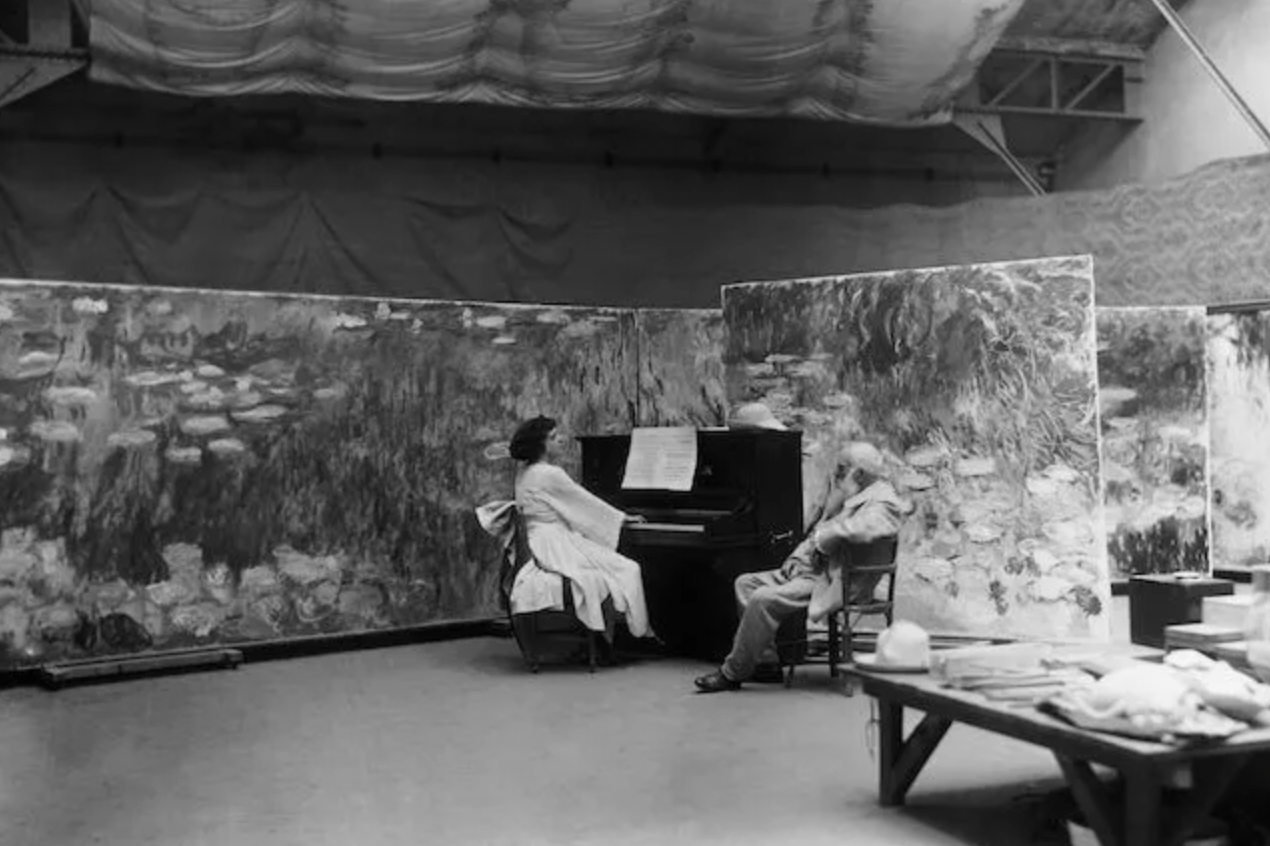
Claude Monet in his studio with several of his water lilies (1897 - 1926).
J. R. R. Tolkien spent more than a decade writing The Lord of the Rings, constructing languages, histories, and entire cosmologies before there was certainty anyone would read them. The depth readers feel was accumulated slowly, largely in private.
The first Avatar film underwent a fifteen-year development process. James Cameron conceived the project in the mid-1990s but waited until technology had advanced sufficiently to realise it fully. He understood that the vision required conditions that did not yet exist, and he allowed time to close that gap.
At five months, none of these would have inspired confidence.
It is like the modern saying, “everyone wants a village, but no one wants to be a villager.” We can liken this to humanity wanting masterpieces, but rarely tolerating the time required to produce them. These stories offer a powerful reminder: meaningful work takes time and usually far longer than we can mentally imagine.
In the studio, there are weeks where nothing appears to move. The same questions. The same surface. The same uncertainty. From within it, it is impossible to tell whether the work is deepening or going nowhere. These in-between stages can last years. They are also the stages most vulnerable to premature judgement.
Right now I am working on a painting whose underlying drawing took four months, and each few centimetres of painted surface takes roughly two hours of concentrated work. It means the work may take at least six to twelve months further to complete. It is not a patch on Gaudí or James Cameron’s timelines, but it nevertheless takes a certain degree of faith and trust that the work is worthwhile to see it through, and allow it to be slow. In earlier years I think I honestly was distracted from producing such works, as I felt I ought to be posting new works daily or weekly on Instagram and social media. I wanted to be ‘seen’ as productive and therefore relevant and moving forward. When in actuality much of the work that was produced during those periods lacked the ambition, authenticity, and depth that, without those outer distractions, I now have no problem delving into. The way I work now demands that I do not allow myself to be distracted by outer demands and remind myself regularly that if I give it a year (for one work) or five years for twenty to thirty works, the timeline is slow, yet by the end of it there is a chance to hold something infinitely more valuable and undeniable in confidence.
When we are inside the long middle, building, refining, and maintaining our trust in ourselves and in the value of time, we may just find the most meaningful work we could ever expect to produce. Certainly, five months is not a verdict; it is barely an introduction. If something matters…if it is built with seriousness and care, it will almost certainly take longer than feels comfortable. Longer than others expect. Longer than our culture rewards.
