The Warmth of Creative Spaces
It has not been long since I began inhabiting a studio space inside Glasgow’s East End, in the WASPS building at 77 Hanson Street. Housing close to two hundred artists, and makers, it is surprising how quiet the corridors can be.
Each morning, walking through the building with a coffee in hand, there is barely a sound. Perhaps only the soft knock of a hammer somewhere down the hall echoing faintly through the small communal kitchenette containing one microwave, one kettle and a few cartons of different kinds of milk, always unlabelled yet somehow respectfully left untouched for their rightful anonymous owners. And yet behind each closed door entire worlds are unfolding.
There are occasional moments of encounter when two strangers, although technically neighbours, quietly emerge to make tea before quickly retreating once more behind their solitary studio doors to continue conversations instead with their materials.
It has also not been long since I began inhabiting Glasgow itself. After the last decade spent between Oxford, London, Lisbon and India, I am still adjusting to what it feels like to root into this city. The colder weather, the long grey stretches and the constant negotiation with rain. Despite being raised in Scotland, this country often feels strangely foreign to me. Meanwhile my husband, having grown up in Eastern India, never quite adjusts to the endless woollen layers, hot water bottles and ritual of trying to remain warm. Between us, we often long for the heat and familial community that comes with Asian life.
Despite the colder climate, there is something undeniably warm here in another element.
For years I heard artists speak about Glasgow with an affection for its friendly locals and championing its vibrant arts community. Arriving here, I began to understand how much care, persistence and human effort quietly sit beneath that reputation.
As I begin shaping the early tangible stages of Slow Burn Studio, I find myself thinking more deeply about this, and the spaces that encourage creativity to exist and persist in the first place, because for many artists, writers, musicians and independent makers, the studio is often an intensely solitary place. Entire days or weeks can pass in solitude and projects can emerge without another person witnessing them until months or years later.
Opening the studio doors, in these early days has brought to light how many people are searching for spaces to create and gather. As a practising artist, remaining connected to making is something I perhaps take for granted simply because creativity has remained such a constant thread throughout my life for almost two decades. But increasingly I find myself wondering what happens when creative instinct no longer has anywhere to live. What happens to the part of a person that once felt connected to making, only for those impulses to slowly disappear beneath work and the practical structures of adulthood?
The local response to sharing Slow Burn Studio publicly has been unexpectedly moving, with messages pouring in from strangers looking to attend classes despite not having drawn in years and others simply pleased that something thoughtful and creative is trying to emerge in their local neighbourhood.
I think underneath all of this sits the word community. A word that has begun to carry more weight, the older I get. Because outside of food, shelter and warmth, what really nourishes a city?
Culture and Community.
Art centres, exhibitions, concerts, libraries, workshops, independent cinemas, communal studios, places where people gather to make sense of themselves and one another.
Culture, creativity and shared space form some of the deepest pillars of nourishment outside of eating a good meal and feeling safe and warm at the end of a long day.
These spaces hold enormous emotional and psychological value, even when difficult to quantify economically.
Call it overstatement, but the arts and cultural spaces within our cities often feel like elders in a family, rich with tradition and the capacity to witness and hold all of our colours. They expand our inner worlds. They offer perspective during periods of isolation and uncertainty. They remind people that there are other ways to live, think, create and imagine.
For years I heard artists speak about Glasgow with an affection for its friendly locals and championing its vibrant arts community. Arriving here, I can understand how much care, persistence and human effort sits beneath that reputation.
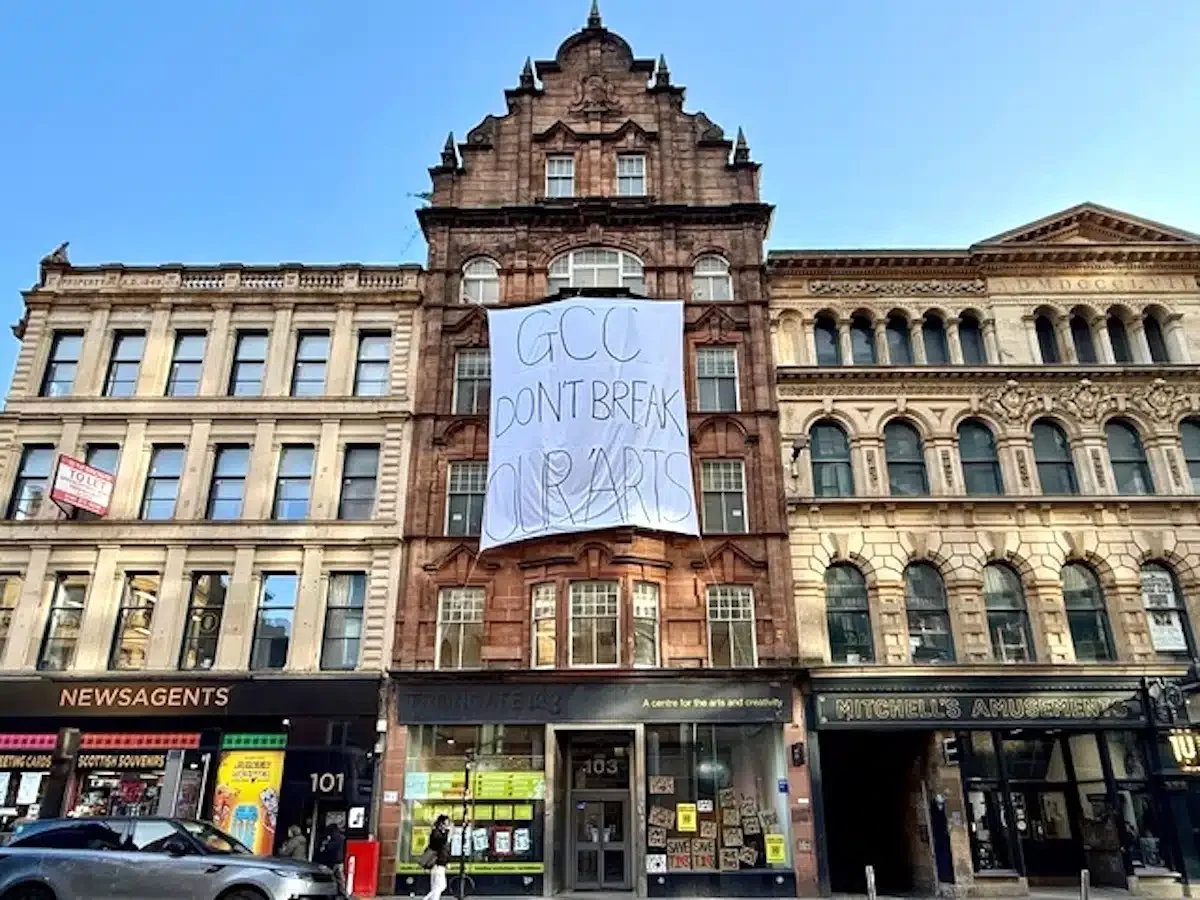
103 ,Trongate, one of Glasgow’s long-standing cultural and creative spaces, April 2026.
Over recent months I have also felt a growing sadness witnessing how precarious many cultural spaces in Glasgow seem to be. Conversations around venues struggling to survive. Studios under pressure. Institutions teetering on uncertain ground. Buildings that contain decades of collective cultural labour are becoming vulnerable to disappearance.
While still new to the city, I have already sensed deep unrest around the fragility of Glasgow’s cultural spaces, from the uncertain future of the much-loved 103, Trongate to the recent closure of the long-standing CCA. Questions around instability, survival and sustainability seem to surface repeatedly amongst artists and local creatives trying to continue meaningful work within the city.
Alongside this, the recent fire at 105 Union Street, a building holding 175 years of history within the city centre felt especially affecting. While not strictly an artist hub, it nevertheless housed design and creative studios containing years of work, labour and lived creative history belonging to local people contributing over time to the fabric of the city.
The loss felt difficult to separate from the memory of the Glasgow School of Art fires, which devastated one of the city’s most significant cultural landmarks first in 2014, and again during restoration works in 2018. That same year, Victoria’s Nightclub on Sauchiehall Street was also lost to fire, further marking the city with a strange sequence of cultural absences.
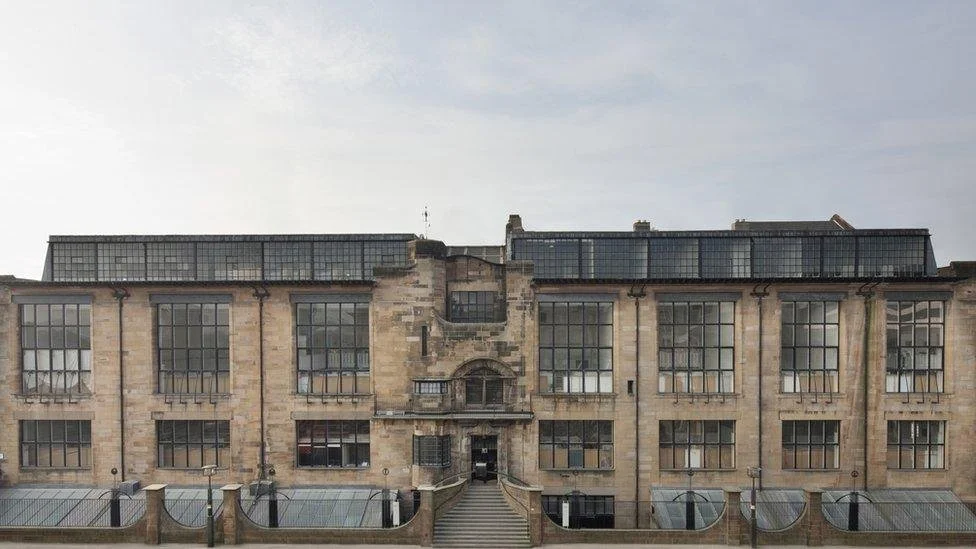
The full north facade of Mackintosh's Glasgow School of Art, taken before the 2014 fire. Photo credit: McAteer Photograph.
These events are not directly connected, and yet I cannot help but feel that when spaces carrying history, creativity and human gathering disappear, something emotional disappears alongside them too, leaving a small hole where life once gathered. And yet perhaps this fragility also reveals how necessary these spaces truly are. People mourn them because they matter.
As someone naturally introverted, it is not entirely within my nature to socialise regularly or place myself visibly at the centre of things. And yet the idea of what researcher Kasley Killam describes as our “social health”, the quality of our human connection and sense of belonging within community, feels increasingly difficult to ignore.
Her work speaks to the understanding that community does not happen accidentally. Like physical or mental health, social health also requires care, participation and spaces where people can gather meaningfully and repeatedly, much like the kinds of encounters that unfold within cultural and creative spaces.
As much as I value solitude, I sometimes catch myself imagining twenty years passing only to realise I never truly built community around myself at all. These thoughts together have fuelled me with a new momentum to cultivate a kind of creative community that does not rest solely on the technical sharing of skills, but on creating a warm and thoughtful space outside more conventional institutional structures.
A space where reflection, curiosity, creativity and human connection can coexist more gently within a world that often feels increasingly hurried and fragmented.
